

Description
Product Description
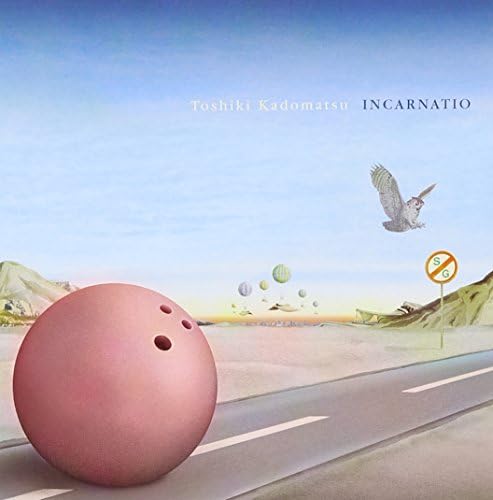
Contents Introduction Kadomatsu's 16th original album, "INCARNATIO," his first in approximately two years, is now complete. Filled with various thoughts and sounds he gained from traveling throughout Japan since around two years ago, this is a truly magnificent album worthy of being called JAPANESE POP MUSIC. Having celebrated his 20th anniversary last year, this is arguably Kadomatsu's finest work, reflecting his increasingly active career. Three key elements of this album are Izumo in Shimane Prefecture, Okinawa, and the Ainu. The Okinawan sanshin, the Ainu stringed instrument tonkori, Okinawan and Ainu choruses, and Izumo, which connects them all?these elements are not presented as world music, but are brilliantly fused into Kadomatsu Toshiki's "POP SOUND." Kadomatsu first visited Izumo in Shimane Prefecture in November 2000, for the filming of his documentary film "FLOW." Since his debut in June 1981, Kadomatsu has consistently incorporated new elements and remained at the forefront of Japan's ever-changing music scene. After a five-year hiatus from 1993 to 1998, he resumed his activities, releasing two albums, "TIME TUNNEL" and "Proof of Existence," as well as two compilation albums. However, he was constantly searching for his path, wondering, "What should I do?" and "Where should I end up?" Furthermore, the more he lived abroad and immersed himself in foreign music culture, the stronger his sense of Japanese identity became. Naturally, his next focus was Japan and the Japanese people. It was in this context that he chose Izumo as the location for his documentary film. Coincidentally, the director of that film was Yoshinari Nishikori, who hails from Izumo. Later, following that, Director Nishikori began production on the film "White Ship," set in his hometown of Shimane, and Kadomatsu was commissioned to compose the film's music. Having received an indescribable spiritual inspiration in Shimane Prefecture, particularly Izumo, Kadomatsu embarked on another journey in 2001 to explore places where he could "feel something with his own sensibilities," a journey to connect with the Japanese spirit. This led him to Okinawa and encounters with the Ainu people. Regarding Okinawa, he had long been interested in Okinawan music. He deepened his relationship with Satoru Shimoji, whom he met on Miyako Island while diving, one of his hobbies, and through this, he gained a deeper understanding of Okinawan history, culture, and spirit, and collaborated with him on the 1999 release "TIME TUNNEL." His relationship with Shimoji has continued ever since. On this trip, the "August Dance," an important intangible cultural property, which he saw on Tarama Island at Shimoji's recommendation, served as a motif for a song on this album. As for the Ainu, Kadomatsu, having learned about them from a TV special on the Ainu and from various materials, felt that they too were an important factor at the root of Japan, and naturally decided to visit them. As Kadomatsu learned about the Ainu spirit, culture, and history of discrimination, his approach to Ainu music naturally emerged, and that's where he met Tonkori player OKI. With no written records remaining (partly because the Ainu culture was originally based on oral tradition), the Tonkori was considered a lost instrument, but OKI revived it. In addition to the three key locations mentioned in this article, Kadomatsu visited various other places, and what he brought together was the soundtrack to the film "The White Ship." In particular, in the theme song "Always Be With You," he successfully blended the sanshin, Tonkori, Okinawan and Ainu chorus, and Izumo Kagura drums into the Kadomatsu sound. This wasn't simply because he was interested in the music and tried to incorporate it; it was the result of trying to understand the culture and spirituality within it as much as possible, and having the other parties understand Kadomatsu as a person as much as possible. The recording features not only the usual members of Kadomatsu's band and renowned musicians, but also the resonant sounds of various types of drums from Tetsuro Naito, a central member of the Niigata/Sado taiko drumming group "Kodo," and the shinobue flute playing of master shakuhachi and shinobue player Hideshi Sato. The album's mixing was handled by GOH HOTODA, who has worked with Madonna and Utada Hikaru, as well as Yasuo Matsumoto, who has worked with Supercar, Denki Groove, Theatre Brook, and Orange Pekoe, and Eiji Uchiyama, whom Kadomatsu trusts implicitly. Mastering was handled by Ted Jansen, America's No. 1 engineer who has worked with Eric Clapton and Green Day. Amazon Review It all started with the soundtrack to the movie "The White Ship." As Toshiki Kadomatsu repeatedly recorded with local musicians in America, he gradually reaffirmed his "roots" in Japan, and it seems that working on the music for this film became a major stepping stone to this album. Titled "Incarnatio," meaning "what lies within the body," this album uses Ainu string instruments, Okinawan sanshin, and female chorus, but through the filter of Kadomatsu's unique pop style, he sings about the hearts of those of us today who are searching for "what remains unchanged." (Hana Kaori)
Media Reviews and More: This is an original album from Toshiki Kadomatsu, marking his 21st year since his debut. It includes 16 tracks in total, including "Always Be With You (Album Version)" and "IZUMO."